Mostrando postagens com marcador Lula. Mostrar todas as postagens

quinta-feira, 28 de abril de 2016

The political path of Dilma Rousseff and its mischiefs

The international media press has been watching Dilma Rousseff's impeachment process from a far position and, based only on official announcements by the government and its representatives, has been calling it a "coup". Before making any judgment about the legitimacy of the process, it's utterly important to understand its accusations and also its defenses. As a reminder I should say it's not my interest to either support or boycott Rousseff's government – my main reason is to inform how things are going on in a less opinionated way, differing from most newspapers and magazines all over Brazil.


Rousseff was first elected as President in 2010, after a large battle against José Serra, her main opponent, with whom she faced a second voting round and won with 56.05% of valid votes. Before being launched as candidate, Rousseff was not a popular figure in Brazil, like her antecessor Luiz Inácio Lula da Silva, but she gained his support on her presidential campaign – they are both from the same political party, PT (standing for Worker's Party). During the first round, Rousseff was competing against the following candidates: José Serra (PSDB, standing for Brazilian Social Democracy's Party), Marina Silva (PV, standing for Green Party), Plínio de Arruda Sampaio (PSOL, standing for Socialism and Liberty Party), José Maria Eymael (PSDC, standing for Social Democrat Christian Party), José Maria de Almeida (PSTU, standing for Unified Workers' Socialist Party), Levy Fidélix (PRTB, standing for Brazilian Worker Renewing Party), Ivan Pinheiro (PCB, standing for Brazilian Communist Party), and Rui da Costa Pimenta (PCO, standing for Factory Workers' Cause Party). According to official data, the 2010 presidential election owned around 101 million of valid votes, from which 47 million were meant for Rousseff, and 33 million, for Serra. The Brazilian law states that a second round is mandatory if none of the candidates reach more than 50% of valid votes – Rousseff reached only 46.91%, and Serra, 32.61%. As a result, both candidates fought against each other, and Rousseff won over Serra's percentage of 43.95%.


During her first government, Dilma Rousseff had hard times as a politician, since she had never been elected to any public occupation before. So she didn't have enough political experience, which led her to be truly unpopular amidst parliamentarians, making decision takings harder than usual. Throughout the four years of her command, she had Lula as her mentor and a present figure beside her, since he was a very popular president and has agreements with many important people into political sphere. Although, Rousseff was not a great politician, which led to her unpopularity as President, not only nationally, but also internationally (she doesn't have the same appeal as Lula to make deals with other countries), seen as an impassive Head of State (as she hardly ever negotiates with the Parliament, both Federal Senate and Chamber of Deputies, to approve her Constitutional Amendments).


In 2013, Rousseff faced a great political crisis when people rioting against, at first, the increase of bus tickets' price, but, shortly after, against the whole sickness of Brazilian political system. Her effiency as a President started being questioned, because of her mistakes as an administrator, so when she announced that she was running for re-election in 2014, it was quite unclear if she was capable of reconquering her popularity in time.


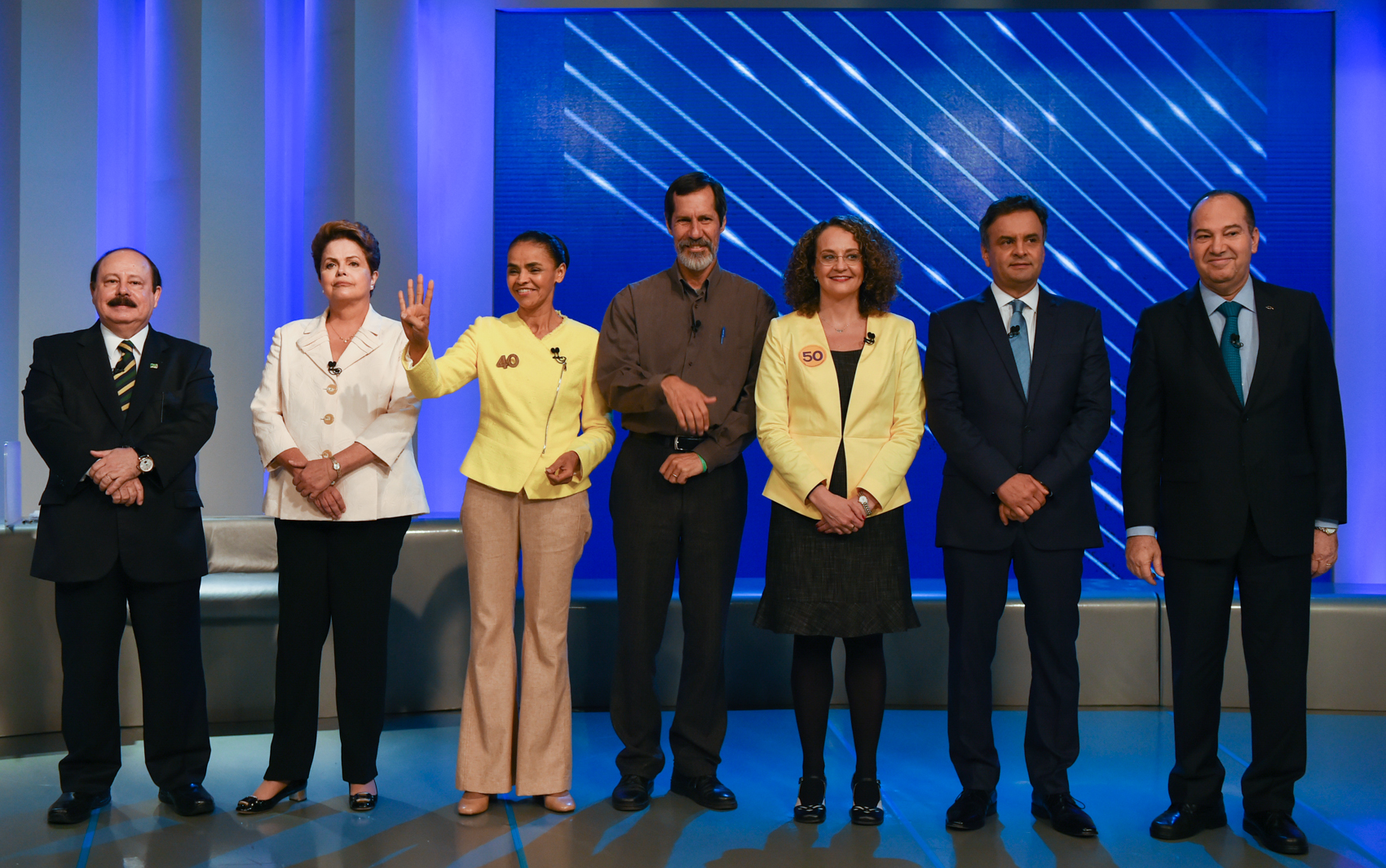
For 2014 presidential election, Rousseff faced competition against these candidates: Aécio Neves (PSDB), who faced the second round against her; Marina Silva (PSB, standing for Brazilian Socialist Party); Luciana Genro (PSOL); Eduardo Jorge (PV); Levy Fidélix (PRTB); José Maria de Almeida (PSTU); José Maria Eymael (PSDC); Mauro Iasi (PCB); e Rui da Costa Pimenta (PCO). Although Neves was the candidate who reached the second round, after receiving 33.55% of valid notes (Rousseff received 41.59%), he was almost defeated by increasing popularity of Marina Silva, who tried to run for election by a brand-new party, Rede Sustentabilidade (standing for Sustainability Network) but was ultimately prevented to get the party's registration and ran to another party, PSB. Silva, despite this confusion, owned 22 million votes, which is definitely not negligible.


However, the second round was fought by Rousseff and Neves, with the President being re-elected with 51.64% of valid votes, against 48.36% for Neves. In comparison to her first victory, Rousseff's popularity had clearly decreased, such as her acceptance as a leader among parliamentarians. In addition, Rousseff made a bunch of promises during the presidential run but she simply accomplished exactly the opposite of most of them right after being re-elected. She promised to lower oil's price – the price had a great increase shortly after the election and has been like this since then. She promised to resume the increase of economy – Brazil faces its worst economic crisis, with two following years of recession. She promised to control inflation – the target ceiling was surpassed, and now inflation is at 9.0%, its worst result since 2003. She promised not to increase interest rate – the basic interest rate (Selic) is currently 14.25%, since inflation is forcing its increase. She promised not to increase energy bill – since her re-election, the electric energy's price had increased 44.75%. She also promised many other things, as written in her government plan, presented during the election, containing around 55 promises.


Besides all these unaccomplished campaign promises, since they didn't fully depend on the President's willing, another big trouble led to the massive dissatisfaction with Rousseff: the "pedaling taxes", or the financial maneuver to hide the poor reality behind Brazilian economic situation, presenting lower expenses to a lured society and National Treasury. This is the main accusation against Rousseff on the impeachment process – crime of fiscal responsibility – and that's why people are complaining about the legitimacy of it, as some don't consider "pedaling taxes" a crime because it is a common practice in nowadays' politic sphere. Many Governors from Brazilian states had already practiced this bureaucratic failure, which implies in luring the Treasury by hiding real accounting data, intending to divert public funds to finance the unfortunately endemic corruption. As a result, the main excuse used by Rousseff's defense is that the practice is not illegal and that accusation is not only irresponsible but also an attempt to force a new government over the democratically elected one. Let's be clear: according to the Criminal Code, the "pedaling taxes" practices are implied under the crime of financial statement makeup – a variation of crime of fiscal responsibility -, liable on conviction of one or two years of prison. Also, it can be inferred from the Law n. 1,079, from 04/10/1950, that the President, if caught breaking the Budget Law, can be convicted of its crime and evicted from the Head Office. Finally, the accusation against Rousseff is not an illegitimate attempt of coup, but a real crime committed by her and her political allies, and it must be punished according to what the law says.

quinta-feira, 21 de abril de 2016

Deputies and their struggles during the voting for Rousseff's impeachment process

The plenary session at the Chamber of Deputies on last Sunday (April 17th), in which the impeachment process against President Dilma Rousseff was voted favorable, was a huge mess throughout the whole period of nine hours that it took to happen. Exceptionally working during the weekend, the deputies were very pettish and exalted while live on national TV to declare their votes. Many parliamentarians were arguing in front of cameras and the press, and they also used their time at the microphone to criticize their colleagues and enemies while they were supposed to voted "yes" or "no" for the subject in discussion. In addition, while they were giving their speeches, most of representatives dedicated their votes for random people, from their relatives and wives, to militaries previously involved in tortures during the Brazilian dictatorial government, which led the Internet to make fun of them creating memes and all kinds of jokes and mocks. Unfortunately this is the imagery of Brazil abroad - a completely messy country, with corruption everywhere, and a frankly unstable democracy.


One of the most disturbing presences in the session was the Federal Deputy Paulo Maluf (PP/SP, standing for the Progressive Party in São Paulo). Maluf is a widely known figure for Brazilians - since the 1960s he had been involved with politics, having already been mayor in São Paulo city, governor in São Paulo estate, and many other occupations, but have been in decadence since the ends of the 1990s, when he had troubles while occupying the Town Hall of São Paulo and was firstly investigated under the accusations of active corruption during the Mensalão case, when he was one of the right-hand men of former President Luiz Inácio Lula da Silva, widely known for his surname Lula. Nowadays, Maluf is still a parliamentarian because nothing has been officially proven against him in previous investigations about his direct involvement with any corruption scandal; in the other hand, he is included in Interpol Red Diffusion since 2010, which means he cannot run abroad Brazil or, otherwise, he might risk being arrested in more than 180 countries. After the troubles caused by his involvement in Mensalão, Maluf was sidelined by Lula and the left-wing government; for this reason, he has been a wide critic of Rousseff's leading, voting favorable for her impeachment.


Another curious parliamentarian present in the voting was Federal Deputy Francisco Everardo Oliveira Silva, widely known for his surname Tiririca (PR/SP, standing for Republic's Party in São Paulo). Elected in 2010 to occupy a chair in the Chamber of Deputies, Tiririca wrote his name in the estate political history, being the third most voted deputy to be elected in the history of Brazil, earning more than 1,300 million votes at the time. Before being a politician, however, Tiririca was already famous in Brazil for his career as a humorist and circus clown - he had been presenting as a clown since his eight years old, and became a popular figure after signing a contract with Universal Music and recording the song "Florentina", which became a big hit and sold more than 1,5 million of copies. He was also a famous humorist on TV, appearing in most of known TV shows all over Brazil. When he was invited to launch his candidacy as federal deputy, his motto was a joke - or not: "Worst than that, it can't be", talking about the bad reputation of Brazilian political system. Curiously, Tiririca was, since he entered the Parliament, the most frequent parliamentarian, being present in 100% of plenary sessions - he was followed by only nine other deputies, from a total amount of 513. His vote favorable to Rousseff's impeachment was controversial - PT (standing for Worker's Party, the political party of Rousseff) was very upset after Tiririca broke his promise of voting against the process. Since then, he was taunted in an airport by some supporters of the party, claiming he is traitor and doesn't take seriously his job as a politician.


Finally, the most controversial event that happened during the voting session was the squabble between the parliamentarians Jean Wyllys (PSOL/RJ, standing for Socialism and Liberty Party in Rio de Janeiro) and Jair Bolsonaro (PSC/RJ, standing for Social Christian Party in Rio de Janeiro). Firstly, Bolsonaro was called by the President of Chamber of Deputies, Mr. Eduardo Cunha, to declare his vote for the impeachment process. The deputy made a angry speech about his dismissal with all of his colleagues who were favorable for Rousseff's continuity as President, and dedicated his "yes" to the militaries who took the Brazilian government in 1964, and also to Colonel Carlos Alberto Brilhante Ustra, ex-chief of DOI-CODI, responsible for all tortures throughout the dictatorial period. Rousseff is widely known for being an ex-guerrilla fighter, who was arrested in 1970 and tortured in prison; so, Bolsonaro's speech was seen as a disrespectful twaddle against the President, and now he's being sued for his words. After this, Wyllys, known for being an ex-participant in TV reality show "Big Brother" and for his work as a deputy for the LGBT community, was called to declare his vote and, once there, made a speech about the foolishness of the impeachment process, hailed Rousseff's government, and declared "no" to her exit. When he was finishing his speech, Bolsonaro, who was standing behind Wyllys, cursed him by offending his sexuality. In response, Wyllys spat on Bolsonaro's face, and also took a spit from Eduardo Bolsonaro, Jair's son and also a federal deputy. For yet unknown reasons, the Legislative Police didn't interfere in none of the confusions between the parliamentarians during the voting process, despite constant appeals from Eduardo Cunha.


Certainly some conclusions can be extracted from these events: first, the Chamber of Deputies wasn't ready at all for this messy plenary session, as seen on images from that day, showing a truly messed up room with many men stood up and screaming to each other; second, Brazilian politicians are covered in mud until their necks, which can be inferred from their curricula as parliamentarians and their previous activities before entering the politics; and third, prejudice and religious extremism are both cancers for the proper functioning of Brazil as a serious country, and for human development , seen that none of them help in teaching kids about great social values. As long as it is completely unacceptable that a parliamentarian uses the figure of a torturer as an example of conduct, it is as unacceptable as another parliamentarian spits on a colleague's face during an official and professional event, being massively registered by all kinds of media outlets. As long as having a representative being chased by Interpol is insanely outrageous, having a President heavily involved with corruption scandals and the biggest robbery in a public enterprise (Petrobras, the oil company which originated the investigation under Rousseff's impeachment process) is as outrageous as Maluf still being eligible to hold public offices.