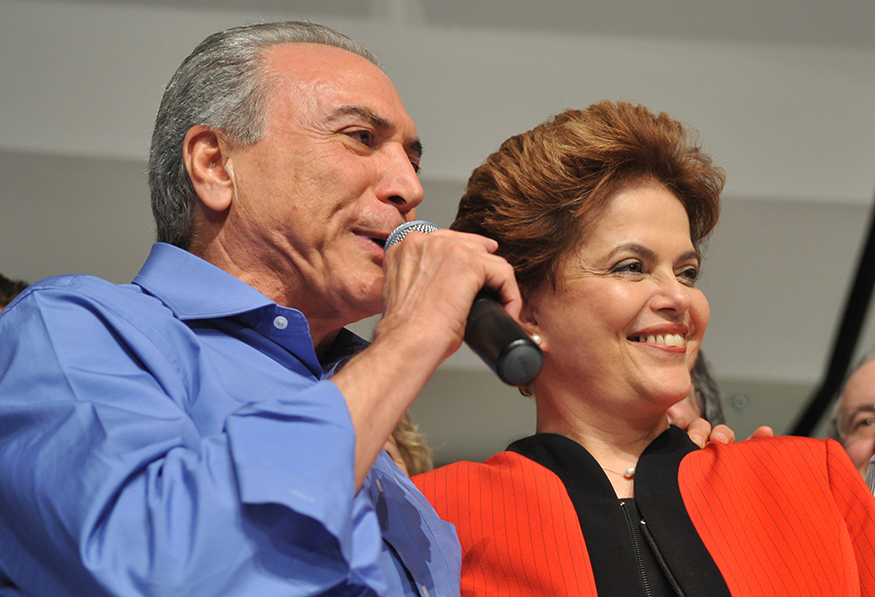
However, his action is completely illegal and has no legal support to proceed – not only he’s only the Interim President, replacing Eduardo Cunha, who was impeached to continue his regular mandate due to serious accusations of active corruption and other crimes against the National Treasury, but he wasn’t yet the Chief when the voting happened, so he supposedly should not interfere on actions taken previously his come-in. Although I am not any attorney to correctly judge the legality of Maranhão’s procedure, I guess that retroactive interference in court decisions taken by a collective of parliamentarians is not only illegal but also unquestioningly criminal, since Maranhão voted against the impeachment process in the previous voting and, now that he’s in charge, he is doing all he can to deny a massively popular decision in time to help his own private interests.
Mostrando postagens com marcador Chamber of Deputies. Mostrar todas as postagens
segunda-feira, 9 de maio de 2016
The nonsense of Waldir Maranhão and his run to instantaneous fame
Just days after assuming the Presidency of the Chamber of Deputies, the deputy Waldir Maranhão (PP/MA, standing for Progressist Party from the state of Maranhão) has taken a surprising yet illegal decision on the morning of this Monday (9) – he simply annulled the plenary session in which the impeachment process against the current President of Brazil, Ms. Dilma Rousseff, was voted and approved by the majority of parliamentarians present there, without previous consulting to his colleagues nor the Internal Regiment of the House. If his action proceeds in the Parliament, the process should come back to the Chamber of Deputies to be voted again.
However, his action is completely illegal and has no legal support to proceed – not only he’s only the Interim President, replacing Eduardo Cunha, who was impeached to continue his regular mandate due to serious accusations of active corruption and other crimes against the National Treasury, but he wasn’t yet the Chief when the voting happened, so he supposedly should not interfere on actions taken previously his come-in. Although I am not any attorney to correctly judge the legality of Maranhão’s procedure, I guess that retroactive interference in court decisions taken by a collective of parliamentarians is not only illegal but also unquestioningly criminal, since Maranhão voted against the impeachment process in the previous voting and, now that he’s in charge, he is doing all he can to deny a massively popular decision in time to help his own private interests.
It might be quite impressive that, since Cunha was taken away from the Presidency of the House, the only parliamentarian he received to a formal meeting was Maranhão, which took a long hour from their time. It is presumed that Cunha instructed his successor to take his decision, although the former President of the Chamber of Deputies had positioned himself completely in favour of Rousseff’s impeachment due to her lack of collegiality during Cunha’s legal process to impeach him. Since there were no reciprocity, Cunha established he would continue Rousseff’s process until the end, which came when he was impeached after the expedition of an injunction. The press has been speculating that Cunha had made a deal with Rousseff, after his exit, to trade a mutual aid, and that is the reason why Maranhão, a previously illustrious unknown figure to most of Brazilians, took a so-careless decision during this hugely messy period the country is going through.
On the afternoon of this Monday, Renan Calheiros, the current president of the Federal Senate, announced that he was utterly against Maranhão’s procedure and that he would continue Rousseff’s impeachment process in the House he presides, as this decision was taken without any previous legal procedure nor any consulting to the voters involved. Said that, we can infer that Maranhão was only pursuing his fifteen minutes of fame as the Interim President of the Chamber of Deputies, and, for now, does not represent great danger to the power that emanates from the people.
However, his action is completely illegal and has no legal support to proceed – not only he’s only the Interim President, replacing Eduardo Cunha, who was impeached to continue his regular mandate due to serious accusations of active corruption and other crimes against the National Treasury, but he wasn’t yet the Chief when the voting happened, so he supposedly should not interfere on actions taken previously his come-in. Although I am not any attorney to correctly judge the legality of Maranhão’s procedure, I guess that retroactive interference in court decisions taken by a collective of parliamentarians is not only illegal but also unquestioningly criminal, since Maranhão voted against the impeachment process in the previous voting and, now that he’s in charge, he is doing all he can to deny a massively popular decision in time to help his own private interests.
quinta-feira, 21 de abril de 2016
Deputies and their struggles during the voting for Rousseff's impeachment process
The plenary session at the Chamber of Deputies on last Sunday (April 17th), in which the impeachment process against President Dilma Rousseff was voted favorable, was a huge mess throughout the whole period of nine hours that it took to happen. Exceptionally working during the weekend, the deputies were very pettish and exalted while live on national TV to declare their votes. Many parliamentarians were arguing in front of cameras and the press, and they also used their time at the microphone to criticize their colleagues and enemies while they were supposed to voted "yes" or "no" for the subject in discussion. In addition, while they were giving their speeches, most of representatives dedicated their votes for random people, from their relatives and wives, to militaries previously involved in tortures during the Brazilian dictatorial government, which led the Internet to make fun of them creating memes and all kinds of jokes and mocks. Unfortunately this is the imagery of Brazil abroad - a completely messy country, with corruption everywhere, and a frankly unstable democracy.
One of the most disturbing presences in the session was the Federal Deputy Paulo Maluf (PP/SP, standing for the Progressive Party in São Paulo). Maluf is a widely known figure for Brazilians - since the 1960s he had been involved with politics, having already been mayor in São Paulo city, governor in São Paulo estate, and many other occupations, but have been in decadence since the ends of the 1990s, when he had troubles while occupying the Town Hall of São Paulo and was firstly investigated under the accusations of active corruption during the Mensalão case, when he was one of the right-hand men of former President Luiz Inácio Lula da Silva, widely known for his surname Lula. Nowadays, Maluf is still a parliamentarian because nothing has been officially proven against him in previous investigations about his direct involvement with any corruption scandal; in the other hand, he is included in Interpol Red Diffusion since 2010, which means he cannot run abroad Brazil or, otherwise, he might risk being arrested in more than 180 countries. After the troubles caused by his involvement in Mensalão, Maluf was sidelined by Lula and the left-wing government; for this reason, he has been a wide critic of Rousseff's leading, voting favorable for her impeachment.
Another curious parliamentarian present in the voting was Federal Deputy Francisco Everardo Oliveira Silva, widely known for his surname Tiririca (PR/SP, standing for Republic's Party in São Paulo). Elected in 2010 to occupy a chair in the Chamber of Deputies, Tiririca wrote his name in the estate political history, being the third most voted deputy to be elected in the history of Brazil, earning more than 1,300 million votes at the time. Before being a politician, however, Tiririca was already famous in Brazil for his career as a humorist and circus clown - he had been presenting as a clown since his eight years old, and became a popular figure after signing a contract with Universal Music and recording the song "Florentina", which became a big hit and sold more than 1,5 million of copies. He was also a famous humorist on TV, appearing in most of known TV shows all over Brazil. When he was invited to launch his candidacy as federal deputy, his motto was a joke - or not: "Worst than that, it can't be", talking about the bad reputation of Brazilian political system. Curiously, Tiririca was, since he entered the Parliament, the most frequent parliamentarian, being present in 100% of plenary sessions - he was followed by only nine other deputies, from a total amount of 513. His vote favorable to Rousseff's impeachment was controversial - PT (standing for Worker's Party, the political party of Rousseff) was very upset after Tiririca broke his promise of voting against the process. Since then, he was taunted in an airport by some supporters of the party, claiming he is traitor and doesn't take seriously his job as a politician.
Finally, the most controversial event that happened during the voting session was the squabble between the parliamentarians Jean Wyllys (PSOL/RJ, standing for Socialism and Liberty Party in Rio de Janeiro) and Jair Bolsonaro (PSC/RJ, standing for Social Christian Party in Rio de Janeiro). Firstly, Bolsonaro was called by the President of Chamber of Deputies, Mr. Eduardo Cunha, to declare his vote for the impeachment process. The deputy made a angry speech about his dismissal with all of his colleagues who were favorable for Rousseff's continuity as President, and dedicated his "yes" to the militaries who took the Brazilian government in 1964, and also to Colonel Carlos Alberto Brilhante Ustra, ex-chief of DOI-CODI, responsible for all tortures throughout the dictatorial period. Rousseff is widely known for being an ex-guerrilla fighter, who was arrested in 1970 and tortured in prison; so, Bolsonaro's speech was seen as a disrespectful twaddle against the President, and now he's being sued for his words. After this, Wyllys, known for being an ex-participant in TV reality show "Big Brother" and for his work as a deputy for the LGBT community, was called to declare his vote and, once there, made a speech about the foolishness of the impeachment process, hailed Rousseff's government, and declared "no" to her exit. When he was finishing his speech, Bolsonaro, who was standing behind Wyllys, cursed him by offending his sexuality. In response, Wyllys spat on Bolsonaro's face, and also took a spit from Eduardo Bolsonaro, Jair's son and also a federal deputy. For yet unknown reasons, the Legislative Police didn't interfere in none of the confusions between the parliamentarians during the voting process, despite constant appeals from Eduardo Cunha.
Certainly some conclusions can be extracted from these events: first, the Chamber of Deputies wasn't ready at all for this messy plenary session, as seen on images from that day, showing a truly messed up room with many men stood up and screaming to each other; second, Brazilian politicians are covered in mud until their necks, which can be inferred from their curricula as parliamentarians and their previous activities before entering the politics; and third, prejudice and religious extremism are both cancers for the proper functioning of Brazil as a serious country, and for human development , seen that none of them help in teaching kids about great social values. As long as it is completely unacceptable that a parliamentarian uses the figure of a torturer as an example of conduct, it is as unacceptable as another parliamentarian spits on a colleague's face during an official and professional event, being massively registered by all kinds of media outlets. As long as having a representative being chased by Interpol is insanely outrageous, having a President heavily involved with corruption scandals and the biggest robbery in a public enterprise (Petrobras, the oil company which originated the investigation under Rousseff's impeachment process) is as outrageous as Maluf still being eligible to hold public offices.
One of the most disturbing presences in the session was the Federal Deputy Paulo Maluf (PP/SP, standing for the Progressive Party in São Paulo). Maluf is a widely known figure for Brazilians - since the 1960s he had been involved with politics, having already been mayor in São Paulo city, governor in São Paulo estate, and many other occupations, but have been in decadence since the ends of the 1990s, when he had troubles while occupying the Town Hall of São Paulo and was firstly investigated under the accusations of active corruption during the Mensalão case, when he was one of the right-hand men of former President Luiz Inácio Lula da Silva, widely known for his surname Lula. Nowadays, Maluf is still a parliamentarian because nothing has been officially proven against him in previous investigations about his direct involvement with any corruption scandal; in the other hand, he is included in Interpol Red Diffusion since 2010, which means he cannot run abroad Brazil or, otherwise, he might risk being arrested in more than 180 countries. After the troubles caused by his involvement in Mensalão, Maluf was sidelined by Lula and the left-wing government; for this reason, he has been a wide critic of Rousseff's leading, voting favorable for her impeachment.
Another curious parliamentarian present in the voting was Federal Deputy Francisco Everardo Oliveira Silva, widely known for his surname Tiririca (PR/SP, standing for Republic's Party in São Paulo). Elected in 2010 to occupy a chair in the Chamber of Deputies, Tiririca wrote his name in the estate political history, being the third most voted deputy to be elected in the history of Brazil, earning more than 1,300 million votes at the time. Before being a politician, however, Tiririca was already famous in Brazil for his career as a humorist and circus clown - he had been presenting as a clown since his eight years old, and became a popular figure after signing a contract with Universal Music and recording the song "Florentina", which became a big hit and sold more than 1,5 million of copies. He was also a famous humorist on TV, appearing in most of known TV shows all over Brazil. When he was invited to launch his candidacy as federal deputy, his motto was a joke - or not: "Worst than that, it can't be", talking about the bad reputation of Brazilian political system. Curiously, Tiririca was, since he entered the Parliament, the most frequent parliamentarian, being present in 100% of plenary sessions - he was followed by only nine other deputies, from a total amount of 513. His vote favorable to Rousseff's impeachment was controversial - PT (standing for Worker's Party, the political party of Rousseff) was very upset after Tiririca broke his promise of voting against the process. Since then, he was taunted in an airport by some supporters of the party, claiming he is traitor and doesn't take seriously his job as a politician.

Certainly some conclusions can be extracted from these events: first, the Chamber of Deputies wasn't ready at all for this messy plenary session, as seen on images from that day, showing a truly messed up room with many men stood up and screaming to each other; second, Brazilian politicians are covered in mud until their necks, which can be inferred from their curricula as parliamentarians and their previous activities before entering the politics; and third, prejudice and religious extremism are both cancers for the proper functioning of Brazil as a serious country, and for human development , seen that none of them help in teaching kids about great social values. As long as it is completely unacceptable that a parliamentarian uses the figure of a torturer as an example of conduct, it is as unacceptable as another parliamentarian spits on a colleague's face during an official and professional event, being massively registered by all kinds of media outlets. As long as having a representative being chased by Interpol is insanely outrageous, having a President heavily involved with corruption scandals and the biggest robbery in a public enterprise (Petrobras, the oil company which originated the investigation under Rousseff's impeachment process) is as outrageous as Maluf still being eligible to hold public offices.
Boomarks:
Brazil,
Carlos Alberto Brilhante Ustra,
Chamber of Deputies,
Dilma Rousseff,
Eduardo Cunha,
Impeachment,
Jair Bolosonaro,
Jean Wyllys,
LGBT,
Lula,
Paulo Maluf,
Tiririca
Understanding Dilma Rousseff's impeachment process and the line to the Executive branch
On the last Sunday (August 17th), the Brazilian Chamber of Deputies voted the impeachment request to the current President of Brazil, Ms. Dilma Vana Rousseff, which was approved by the majority of the present deputies – the actual scoreboard was 367 votes in favor of the request, 137 against it, and two absences. As a result of this voting process, the legal issue will now be voted at the Federal Senate. The legal process there will start very soon, with the election of a special committee to analyze the issue, and if hold until the end with favorable result to all Rousseff's political opponents, the President will be deprived of her services and her political rights will be impeached for a period of eight years. The President is being accused of crimes of fiscal responsibility and against the Treasury, mainly because of the recently discovered makeup in the accounting records, the infamous "pedaling taxes" – a budgetary maneuver to delay transfers of public money to banks (private and public ones) and authorities, luring the financial market to present lower expenses than it really was.
Said this, we do need to talk about the line to the Executive branch – the actual representatives in the government have all legal issues holding their backs, as they are accused of active corruption, money laundering, misuse of public funds, and several other crimes against the Treasury and in favor of self-benefits. The first one in the line to replace Rousseff is the Vice-President, Mr. Michel Temer – he is being accused of heading the financial transactions which led to the "pedaling taxes", and crimes of fiscal responsibility, since he hasn't help avoiding the economic crisis that overflows the country nowadays. Since these accusations have been spread by the press, an impeachment process was open against Temer in April 6th of the present year, but it was archived by Mr. Renan Calheiros, current President of the Federal Senate, the next day. However, people are unsatisfied with Temer, trying to refrain the idea of having him as the Interim President, so a new process is being studied meanwhile Rousseff is facing hers. If she were impeached, Temer would take the lead by the rest of her presidential term. Nevertheless, if Temer were pulled out of the government by the impeachment process, the next one in the line is the President of the Chamber of Deputies, Mr. Eduardo Cunha.
Eduardo Cunha has been the President of the Chamber of Deputies since February 2015 and, since then, has been target of many critics and of many minority groups due to his hate speech against the LGBT community and Afro-Brazilian religions. Cunha is a notorious evangelical pastor, and was elected with more than 200,000 votes for his third term as Federal Deputy. However, since August 2015, his name was involved in the investigation about the corruption scandal in Petrobras, the biggest oil company in Brazil, named as "Operação Lava-Jato" (Operation Car Wash). The company has been involved in an enormous corruption globalization, which led Petrobras to lose around $1,748 billion in bribery and racketeering. Cunha was accused of being the bridge between his political party (PMDB, standing for Party of Brazilian Democratic Movement) and the International Board of the oil company, receiving around $1,400 million in bribes. Besides, he's been targeted as an extremist religious and as an intolerant of social minorities, such as homosexuals and black people. If he assumes the government, the Federal Constitution of 1988 says he must call the Brazilians for a new election in the period of 90 days – which means the country would begin again the process of choosing a new President right after the abrupt exit of the last one.
In other words: Brazil is filled with corrupt and dishonest politicians in each and every phase of the public sphere, so either Rousseff being expelled or not from the government, people are still struggling with bad character politicians and the budget gap caused by successive and significant corruption scandals involving public funds. Neither Rousseff nor Temer can do any good to Brazil if they continue ruling the country, since they have no more the political support in the National Congress or the wide acceptance of the population. Cunha would be just a temporary chief, but we must be warned about him and his extremism – if he takes enough time, he might undo important changes about the minorities he clearly disrespect in his speeches. If we have the exit of both President and Vice President, this means the Brazilian population had failed in choosing their biggest representative, since Rousseff, when elected, was already with Temer by her side, so they were elected together. The most urgent change to be done in the Brazilian politics is the total eradication of any parliamentarian involved with any corruption accusation from the Legislative Houses but, if we do that now, we might be risking ascend to the maximum power of the country a real circus clown or a retired soccer player – so, any plans of political reform must wait this whole confusion settles down to take place.
.jpg)
Said this, we do need to talk about the line to the Executive branch – the actual representatives in the government have all legal issues holding their backs, as they are accused of active corruption, money laundering, misuse of public funds, and several other crimes against the Treasury and in favor of self-benefits. The first one in the line to replace Rousseff is the Vice-President, Mr. Michel Temer – he is being accused of heading the financial transactions which led to the "pedaling taxes", and crimes of fiscal responsibility, since he hasn't help avoiding the economic crisis that overflows the country nowadays. Since these accusations have been spread by the press, an impeachment process was open against Temer in April 6th of the present year, but it was archived by Mr. Renan Calheiros, current President of the Federal Senate, the next day. However, people are unsatisfied with Temer, trying to refrain the idea of having him as the Interim President, so a new process is being studied meanwhile Rousseff is facing hers. If she were impeached, Temer would take the lead by the rest of her presidential term. Nevertheless, if Temer were pulled out of the government by the impeachment process, the next one in the line is the President of the Chamber of Deputies, Mr. Eduardo Cunha.

Eduardo Cunha has been the President of the Chamber of Deputies since February 2015 and, since then, has been target of many critics and of many minority groups due to his hate speech against the LGBT community and Afro-Brazilian religions. Cunha is a notorious evangelical pastor, and was elected with more than 200,000 votes for his third term as Federal Deputy. However, since August 2015, his name was involved in the investigation about the corruption scandal in Petrobras, the biggest oil company in Brazil, named as "Operação Lava-Jato" (Operation Car Wash). The company has been involved in an enormous corruption globalization, which led Petrobras to lose around $1,748 billion in bribery and racketeering. Cunha was accused of being the bridge between his political party (PMDB, standing for Party of Brazilian Democratic Movement) and the International Board of the oil company, receiving around $1,400 million in bribes. Besides, he's been targeted as an extremist religious and as an intolerant of social minorities, such as homosexuals and black people. If he assumes the government, the Federal Constitution of 1988 says he must call the Brazilians for a new election in the period of 90 days – which means the country would begin again the process of choosing a new President right after the abrupt exit of the last one.

In other words: Brazil is filled with corrupt and dishonest politicians in each and every phase of the public sphere, so either Rousseff being expelled or not from the government, people are still struggling with bad character politicians and the budget gap caused by successive and significant corruption scandals involving public funds. Neither Rousseff nor Temer can do any good to Brazil if they continue ruling the country, since they have no more the political support in the National Congress or the wide acceptance of the population. Cunha would be just a temporary chief, but we must be warned about him and his extremism – if he takes enough time, he might undo important changes about the minorities he clearly disrespect in his speeches. If we have the exit of both President and Vice President, this means the Brazilian population had failed in choosing their biggest representative, since Rousseff, when elected, was already with Temer by her side, so they were elected together. The most urgent change to be done in the Brazilian politics is the total eradication of any parliamentarian involved with any corruption accusation from the Legislative Houses but, if we do that now, we might be risking ascend to the maximum power of the country a real circus clown or a retired soccer player – so, any plans of political reform must wait this whole confusion settles down to take place.
Welcome to Brazil for Foreigners!
Hello, everyone!
My name is Rosa Kälin, and I would like to use this space as an apolitical space. As my main concern is to inform people about all confusion around Brazil's politics, I will try very hard to avoid telling here my private opinion about politics and ideology – so, don't expect to find here left-wing or right-wing opinions. I want this space to explain these hard times in Brazil, as we are facing dark times – not only with the impeachment process against the President, Ms. Dilma Rousseff, but also all the investigations about corruption as in Senate as in Chamber of Deputies – so I'll show here the facts, without ideological bias.
Hope you all enjoy my posts here – and hope you don't misunderstand the usage of this space with a government attack or defense. I'm here to find the best way to show you the truth about all things happening in Brazil. Thanks for your attention!
Regards,
Rosa Kälin
Boomarks:
Brazil,
Brazil for Foreigners,
Chamber of Deputies,
Corruption,
Dilma Rousseff,
Senate,
Welcome
Assinar:
Postagens (Atom)